Is This Relationship Worth Fighting For — Or Is It Time to Let Go?
Discernment coaching is for relationships where one or both of you aren't sure if you want to break up or stay together.

Maybe you're the one who's already halfway out the door. Maybe you're the one still hoping. Maybe you're both just tired, and tired has started to feel like an answer.
Discernment coaching isn't relationship therapy. We're not going to ask you to commit to fixing anything today. We're not on a mission to save your relationship, and we're not going to nudge you toward breaking up either. Our only job is to help you get clarity — real clarity, not the kind you talk yourself into at 2am — about which of three paths makes sense for you.
The Three Paths

Staying as you are
Not deciding. Not changing the pattern, the distance, the way you've learned to move around each other. For some people, this is a genuine choice — a season of stability while other things (health, kids, finances, grief) take priority, or simply an honest acknowledgment that neither of you is ready to move yet. It has real costs: the current pattern doesn't resolve itself just because you've stopped naming it. But it also isn't automatically the "weak" option — sometimes staying, consciously and without illusion, is its own form of clarity.

Breaking up
Ending the relationship. This isn't framed here as failure, and it isn't a bargaining chip to bring your partner into line. It's a real path with its own weight: building two systems, renegotiating shared assets/dependents, telling your loved ones, grieving what you'd hoped this would be. Some people arrive here with relief. Some arrive here with grief and relief at once. Either way, it deserves the same clear-eyed honesty as the other two options — not a euphemism, not a last resort you back into because no one said the word out loud.

Committing to 6 months in dyadic therapy work
A defined stretch of time — typically around six months — where you both go all in on the relationship, with structure and support. Not a trial run. A genuine attempt, with an honest picture of what it would actually require of each of you.
In this path, I will give you a summary of your systemic issues and the individual contributions to those issues for you to give to your couples therapist.

Most people who come to discernment coaching are in some version of a mixed place — one person more out than in, one person still hoping it can work. That imbalance is exactly what this process is built for. You won't be asked to perform togetherness you don't feel. You also won't be talked out of hope you do feel.

What this looks like:
-
A short phone screen first, so we can understand where each of you stands and make sure this is the right fit.
-
Look at 3 sides of your problems:
yours
the other person
coach’s perspective
evaluate the possibility of solving your problems and staying together
decide whether or move towards breaking up or make a last all out effort to restore your relationship to health
understand what has happened in your relationship and your personal contributions to the relationship dysfunction -
Once the discernment sessions are complete, the counselor shares direct observations of the interlocking dynamics seen across the process — the specific ways each partner's patterns reinforce the other's, named without assigning blame to either side. This feedback is offered regardless of which path the couple lands on. What follows it is shaped by that choice: for partners continuing to work on the relationship, the counselor outlines both the individual work each person would need to do on their own patterns and the relational work required to change the dynamic between them. For people breaking up, the focus narrows to the individual work alone — what each person’s patterns mean for them going forward, independent of this relationship. The dyad leaves with clarity on the dynamic itself, and with the scope of effort that matches the path they've actually chosen.

-
![A closed dark green wooden door with a small white doormat in front, flanked by two potted cactus plants, against a light-colored stucco wall, with a security camera on the upper right and a small barred window above.]()
Investment
Your initial consultation, with both of you present, is free. From there: a 120-minute intake session ($1,000), followed by 80-minute follow-up sessions ($640 each), for up to five sessions total. Most couples reach clarity well within that range — this isn't designed to be open-ended.
-
![Front view of a colorful house with a yellow wall on the left and a green wall on the right. The house has two doors, one with a sunburst design and a blue curtain on the left, and a window with a blue curtain on the right. House numbers '121' and '122' are visible above the doors. The ground has gray and white patterned tiles.]()
Why it's structured this way
Open-ended couples therapy can run for a year or more before a couple even agrees on what they're trying to fix — often because no one has done the work of finding out whether both people want to fix the same thing. Discernment counseling front-loads that question, so whatever comes next — repair work, separation, or staying with new clarity — starts from an accurate picture instead of months of guessing.
-
![Front porch of a house with a red door, white decorative trim, black lantern lights on each side, a pumpkin on the left, and fallen autumn leaves on the steps and ground.]()
Real Results
That's true whichever path you're on. Couples who move toward legal separation do it with a clearer, more specific account of what happened, which tends to shorten conflict, not just legal fees. Couples who commit to repair go in knowing exactly which patterns to target, instead of spending the first several months of therapy just figuring that out. Either way, you're not paying to stay confused for longer than you have to.





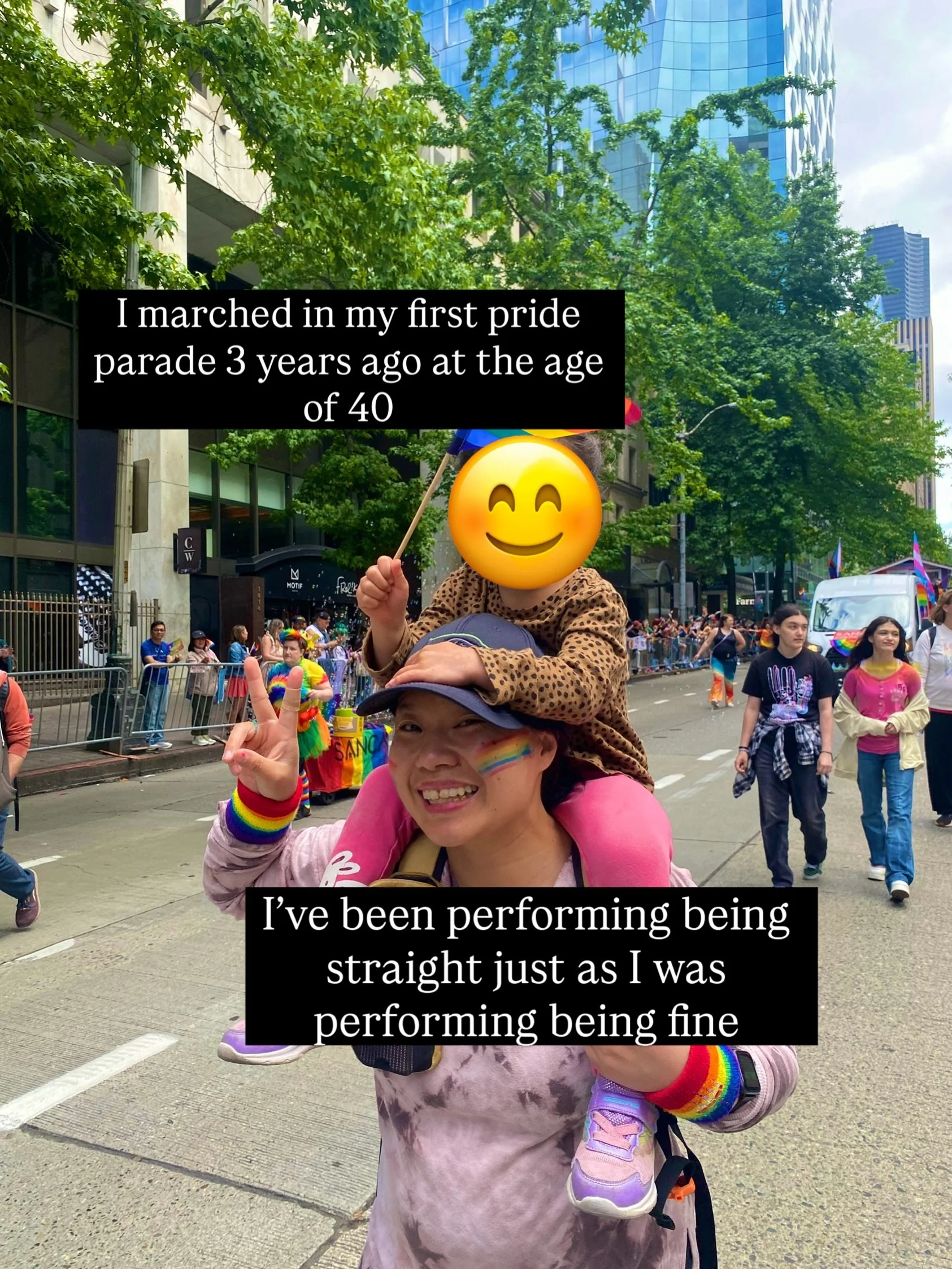
Meet Angela Tam, MA, LMHC
Relationship Coach, Somatic Experiencing Practitioner, Discernment Coach
I'm not going to pretend I only understand this work from the outside.
I know what it feels like when warmth cools into numbness. When numbness hardens into rage. When rage settles into something that feels permanent — a kind of despising you never imagined you were capable of, especially toward someone your children adore. I know the particular guilt of that. The way it sits in your chest when your kids run to your spouse and you're standing there feeling like a stranger in your own family.
I did the work. Ten years of it — slow, nonlinear, unglamorous weekly therapy. And what came out the other side is a marriage I wouldn't have recognized from the floor of the worst of it. We're genuinely close now. We're each other's first call. I don't say that to sell you a fairytale. I say it because I need you to know that I'm not asking you to hope for something I haven't seen with my own eyes.
What turned it wasn't a breakthrough moment. It was the decision — made separately, by two people — to stop waiting for the other person to change first. That radical inward turn is the hardest thing I'll ever ask of you. It's also the only thing that actually works.
In the room, I'm warm and I'm direct. I'm not here to referee or keep the peace. I want to see the real shape of your relationship — including the parts that are hard to show a stranger. You don't have to prove yourself here, or win me over to your side. You just have to be willing to be honest.
I can hold whatever you bring. That's not a performance — it's the result of doing this work on myself, and with couples who were just as far gone as you might feel right now.

The problem isn't the other person. It’s not entirely you either.
Most people arrive focused on the other person’s behavior. What they leave with is something harder to come by — genuine curiosity about themselves.
The conflict cycle you keep repeating isn't the problem. It's the portal. Inside it is every unfinished piece of personal history that never got resolved, now living in the space between you. What's on the other side is real compassion — for yourself, and eventually for each other.
What this asks of you isn't easy. You'll need to set down your pride and take radical responsibility for your part — not after your partner goes first, but regardless. Most couples underestimate how much that costs.
Here's what I tell almost everyone: nobody is only a victim of their relationship. Everyone contributes a gift. Everyone also contributes to the dysfunction. That's not blame — it's actually the most hopeful thing I can offer you.


Ending a relationship is rarely simple, and for many people, it isn't only a practical decision — it's one that touches on the promises made when the relationship began.
Some people feel it matters to have genuinely tried, and to have given their partner honest notice and a real chance to participate in that effort, before deciding to leave. Others don't experience it that way, and that's not treated as a lesser or less thoughtful path here.
Part of this work is making space for that question, if it's one you're already carrying — not deciding it for you, and not suggesting there's a right answer to it.
My role in this isn't to tell you what you owe anyone. It's to help you notice, if it's there, the weight of the commitment you made — and to make sure that if repair is something you haven't actually tried, you're not ruling it out by default rather than by choice. That's different from being talked into staying, and different from being told you have to try again.



Stop Wondering. Start Finding Out.
Not sure if this relationship can work — or if it's time to let it go? You don't have to keep circling that question alone.
Discernment coaching gives you a structured way to find out, in a handful of sessions, with someone who isn't rooting for either outcome.